Posts

Primroses = Spring

Image
Just when I think I can’t stand another minute of winter, the smiling faces and heady fragrance of primroses appear in stores everywhere. These came in their own cache pots, but I’ve also used the plants in small tabletop troughs, indoor window boxes, and ornamental bowls, to make attractive centerpieces. Many primroses are not scented. As with roses, I wonder, “What’s the point?” Yellow and purple primroses are the most likely to exude perfume, but not all of them do. So, I stand at the display and sniff each and every yellow plant to find out whether it’s “the one.” To me, it’s worth the effort. However, I couldn’t resist that bi-color interloper despite its lack of scent --- I figured the other two would make up for it. Select plants that have new buds coming on, or flowers just about to open, and the plants will retain their flowers for two to three weeks with ordinary care. The trick then becomes to find a spot to hold them over until they can go into the ground. Last year, I bro...

Go Play Outside

Image
We’re just back from Bowman’s Hill’s annual Land Ethics Symposium ( http://www.bhwp.org/educational/Symposium.htm ) and I’m all fired up to jump back into the fray and change the world. But what had the biggest effect on me was that two of the presenters spoke of mothers who threw them out the door every morning, pockets stuffed with sandwiches or fruit, and told them to go play outdoors. It reminded me of my own mother, who insisted I play outside and “get some fresh air on your body.” Today’s moms would, no doubt, be horrified that I was out in the woods “cooking” dirt and grass to eat and tasting the barks of various trees and shrubs as I believed the Indians had. Our parents taught my brother and I about the dangers of poison ivy, poison oak, and poison sumac, rattlesnakes and copperheads, so we survived. We returned from our trips to the quarry with pockets full of stones and spent hours poring over our science encyclopedia and field guides trying to identify our “collections,” bi...

Plan Ahead for Dogs in the Garden

Image
A parade of Seeing Eye pups has passed through our garden during the past six years. They arrive, cute as a button at a mere 7 – 10 pounds (that’s Christine), but grow quickly into full-sized Labrador Retrievers that top the scales at 50+ pounds. Our own Emma weighs in at 70. Because a human life may ultimately depend upon a Seeing Eye dog guide, these puppies must be raised in a somewhat more restrictive way than a pet would be, but they’re still allowed to have lots of fun and plenty of play time. At our house that means chasing Frisbees, retrieving balls, and splashing around in the doggie pool (Emma and Harriet). When we added on to our house in 2000, our old garden was completely destroyed by the construction equipment. Gardeners are such optimists! I viewed this as an opportunity for a complete redo. Julie Moir Messervy’s book The Inward Garden was very helpful in visualizing areas for various activities, one of the most important of these being enough running room for two high s...

Green Gardening Gloves

Image
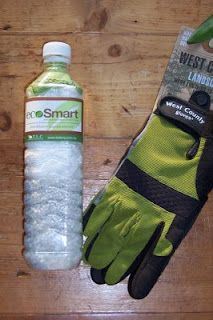
These gloves are green in more ways than one, since they’re made from recycled water bottles. They are constructed with a high-tech spandex mesh fabric derived from recycled PET (polyethylene terephthalate) beverage bottles that have been ground up and spun into recycled yarn. Each pair of the new West County Gardener Work and Landscape gloves removes one 8-ounce beverage bottle from landfills. Using recycled yarn versus virgin polyester yarns provides up to 75% energy savings and reduces green house gas emissions by at least 40%. The recycled fabric, called EcoSmart is tough and light, but just as soft as conventional nylon spandex. I have both kinds and can’t feel any difference in texture or comfort. The Landscape glove is engineered with coated Kevlar © , heavy-duty polyurethane synthetic suede, and a tough-textured polyester palm to stand up to highly abrasive landscape elements such as stone, pavers and trees. Last summer, one of my yard helpers managed to destroy a pair of West...

Targeting Invasive Plants

Image
My latest article, Plant Pests, is featured in the Green Thumb Guide of the Spring 2009 issue of Nature’s Garden, one of the most popular Better Homes and Gardens gardening magazines, on newsstands now. The Nature’s Garden website http://bhgnaturesgarden.com/ offers a place to share your nature photos, to keep a journal, or to participate in garden forums. Take a few minutes now to check it out. For those of us in the conservation trenches, it’s a watershed moment when magazine editors acknowledge that some plants that are still being sold in garden centers across the nation are actually thugs that can drive out native vegetation and destroy habitat. Let’s support those who do. But many invasive plants have been here so long that people mistake them for natives. One of the earliest harbingers of spring (just 50 days away) in our area is the invasive Garlic Mustard (Photo credit: Olivia Kwon) . Like many plants that have taken over our woodlands, Garlic Mustard arrived in America wit...

Gardening as Process: Zeroing-in

Image
At this point, you should have a bubble diagram that shows: Your planned activity areas, both hardscape and plantscape; an inventory of what will be left once you’ve moved, or removed, what you don’t like; and a rough indication of where you want various types of new features and plants --- trees, shrubs, perennials, and annuals. For some, the next step is the most difficult: Choosing how you want your garden to grow. Do you want to look out on masses of a specific color? Do you want to collect a variety of the same species of plants, such as roses, or hostas? Do you want to create a particular kind of garden, such as an alpine garden, a Japanese garden, a vegetable garden, or a cutting garden? Do you want the garden to have a casual look, like a swath of rough grass and meadow? Or do you favor a formal look with edged beds or parterres framed with boxwood? Each of these choices calls for a different selection of plants. Once you’ve made these decisions, it’s time to break out the refe...

Gardening as Process: Editing

Image
Over time, we change, our taste changes, the availability of various plants changes, the amount of time we want to spend in the garden changes and, most telling, our capabilities to manage the physical tasks of gardening changes. What this means to every gardener is that the garden should be periodically edited. When? When it no longer functions as intended, when the flower beds have grown too shady, when the kids no longer use the sandbox or swing set, when the swimming pool lies idle 99% of the time, when the garden no longer gives you the pleasure it once did. And, sadly, when we can no longer maintain what we have. Edit your garden to suit your lifestyle and your budget. As with everything in life, gardening happiness is directly proportional to the difference between our expectations and our ability to achieve them. If you can only afford a $2,000 per year gardening budget, it’s unrealistic to hope that you’ll have a $100,000 landscape at the end of your five- year plan. Better to...