Posts

Showing posts with the label Arbors/Fences/Gates

10 Best Holiday Gifts for Gardeners

Image
How do you know what your gardener wants most? Listen for clues by paying close attention to the gardener's running commentary throughout the year. Among the mumbling and grumbling, you'll hear things such as, "If I just had one more (fill in the blank), it would look perfect," or "One of these days, I'm going to have to get a (fill in the blank)" or the far more subtle, "I really liked how that (fill in the blank) looked in the neighbor's garden. Rather than giving the same old garden gloves or trowel set, this year offer something more imaginative. Here are my top 10 recommendations for the best holiday gifts for gardeners. 1. Ratchet tools. Among the new tools I've pounced upon are ratcheted loppers with telescoping handles that extend at the push of a button, and ratchet pruners. Both forestall that wrist and thumb pain that becomes so common as we age. Gardeners who suffer from arthritis will find they can last longer, with less pai...
Stirring Up the Gardener’s Imagination

Image
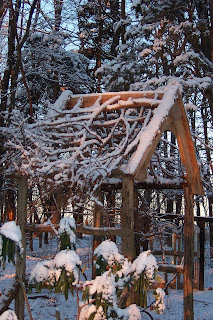
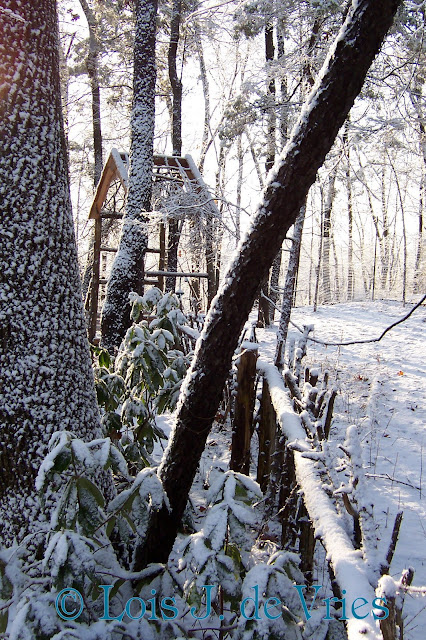
The other day I was asked what my favorite gardening websites are and why. The first one that popped into my mind was Gardening Gone Wild http://www.gardeninggonewild.com/?p=9088 because of its pieces on photography and design, the ability to interact and cross-blog, and the hosts’ ability to generally stir up the imagination of gardeners everywhere. So this post is an entry in GGW’s Picture This Contest for November, aptly named End of the Line. My interpretation is a literal one (top photo) – a winter scene of our cedar arbor at the end of the line formed by a decorative fence that marks the boundary (or end of the line) between where we actively garden and the next, semi-wild zone. But there’s more. There are the horizontal lines of the arbor itself. And the upright lines of the tree trunks and the tips of the fence pickets. The sentry-like vertical forms of the snow-covered rhododendrons. And finally, the curving line of the wild grapevine. Once I started looking for an approp...

Rustic Benches

Image
Here’s a great example of rustic log benches in Red Butte Gardens in Utah. Half-sawn logs are surprisingly comfortable but, of course, you need to get the logs. In less urbanized areas, you can generally find a commercial sawmill, or a woodworker with a portable sawmill, to cut the logs for you. The beefy uprights of these benches are sunk into the ground, but in a more humid climate, you’d want to take additional precautions to prevent premature rotting. Some feel that placing gravel in the post-hole promotes better drainage than filling the hole with concrete, but both work. I prefer the gravel because it’s less labor-intensive and doesn’t leave concrete “stumps” in the ground, should the bench be removed. You may also want to treat the post-end that will go into the ground with a non-toxic preservative. The easiest way to fasten the seat and back to the uprights is probably with log bolts. Dan has used plastic-covered cable threaded through copper pipe to suspend our h...

Custom Gates

Image
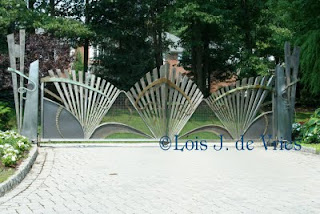
The two gates shown here were hand- crafted: One, a traditional bronze, oriental-style marsh scene with a crane; the other, a contemporary abstract rendered in a variety of metals. Of course, custom gates can be made of wood or other materials, as well. Most custom gates are works of art in their own right, but they are functional art and must be able to withstand the rigors not only of the weather, but also of constantly opening and closing. Perhaps the pre-eminent metal artist of the 20th century was Philadelphia’s Samuel Yellin, whose work graces Bok Tower, Princeton, Harvard, Yale, and other universities, St. John the Divine Cathedral in New York, and many government, public, and private buildings. You can see some of his gates here http://www.samuelyellin.com/history/work/index.html . Today the forge operates under the direction of his granddaughter, Clare. For those with more modest purses, make a sketch of your idea and look for an iron-welding or other metalworks firm. Unless ...

Antique Gates

Image
This antique gate stands at the end of a wisteria-covered pergola and is attached to concrete pillars although, since the pergola itself is constructed of cedar logs, the gates could have been hung from cedar posts, as well. It is a formal exclamation point at the end of a traditional garden structure. It serves the practical purpose of separating this part of the garden from the county road, although it is unlikely that anyone would ever enter the garden this way. But it also serves a specific design purpose. Long, shaded pergolas such as this one provide a sense of enclosure that is similar to a tunnel. The gate is the “light” at the end of it. It serves as a focal point, or resting place, for the eye and implies that the narrow vista is about to open up. The gate could just as easily serve as the entry to an area of open lawn, or a seating area enclosed by hedges. If your heart’s desire is an antique gate, be prepared to pay a hefty price. Most architectural salvage firms host websi...

Rustic Gate

Image
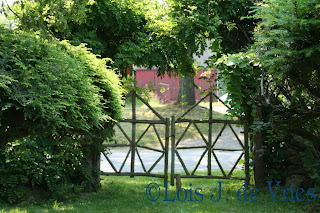
Here’s a simple rustic gate that acts more as a visual boundary than an actual barrier. Its purpose is to stop the eye and separate the pleasure garden from the driveway and the working part of the farm beyond. In this case, it provides access for the lawn tractor, wagons, and other impedimentia of garden maintenance, but works equally well for any transition area in a naturalistic setting. The thick hedge surrounding the gate, the overhanging wisteria vine, and the pointy tops that rise above the frame provide a deterrent for deer, but fawns could certainly ease their way through the diamond-shaped openings. A simple fix would be to tack some deer fencing onto the logs. In a farm-like setting such as this, chicken wire or livestock fencing would also look appropriate, the latter adding some additional reinforcement to the log structure. Stout support posts (hidden by the hedges) should be sunk well into the ground and backfilled with gravel to encourage good drainage. Another school o...

Gardening as Process: Planning and Mapping -1

Image
The next step in creating a garden is to map out what goes where. This can be as simple or complex as you like. You can purchase a computer-based design program, buy a plastic landscape template, or just make a bubble diagram. I prefer to start with a bubble diagram on 11” x 17” quadrille paper, which allows you to work on the larger scale needed to envision an entire yard. Use pencil and get a big eraser. Next, you need to step outside. Look around. What are your lines of sight? Where is your eye naturally drawn? For better or for worse, these are your existing focal points. It’s important to deal with reality here, because you’re gathering vital information that will make or break your garden design. Don’t shrink from drawing an arrow from your back door to your neighbor’s plastic play set, if that is the dominant element in your garden view. Until you address such 800-pound gorillas, the garden will never look right. Compare where your eye is drawn now to where you would like ...

Mid-Season Gardening Resolutions Check-up #1

Image
Did you make some New Year’s gardening resolutions in January, or fantasize about a series of projects to complete before summer’s end? I did (see http://loisdevries.blogspot.com/2008/01/gardening-resolutions-for-new-year.html). Well, it’s mid-July and we’re halfway through the gardening season. Time to check our progress against our plans. With one caveat. In the garden, it seems our imagination is always larger, or more abundant, than our capacity, whether of time, money, or ability. The Golden Dragon Clivia sits on a shaded porch for the summer, per advice from experienced Clivia growers on the garden writers listserv. Once the air conditioner comes out of the window, it will go back to its in-house space. So far, so good. It’s still alive. Climbing roses for the arbor. I got only one that was on my list, Bantry Bay. This was tiny compared to the others I finally purchased, but it is on its own root (not grafted) and I have great hopes for it. I’m disappointed to say I got...

Arbors: Style and Placement

Image
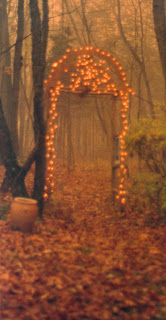
This is Dan’s first arbor, an earlier version of the one pictured in the previous post. While I’m not crazy about the use of twinkle lights in the garden, here they lent an ethereal air to the forest and served a practical purpose, as well: A night light for the doggy relief area during those late nocturnal and early morning runs. Choosing an arbor that is in harmony with the architectural style of the house and the landscape style of the garden, and siting it appropriately, are crucial to having it integrate well into its surroundings. While budget is an issue for many gardeners, as is not having a live-in arbor-artist, there are still many choices available ready made, or with only “some assembly required.” Smooth, unfussy surfaces and sleek styling go well with contemporary, modern, or mid-century homes; ornate curlicues and botanical themes with cottages, farmhouses, and Victorians. Unpeeled logs or rough-sawn boards are good choices for a rustic look. If you are fortunate...

Arbors as Garden Doors

Image
Guest Blog by Dan Freed People are always curious about Dan’s garden structures (left), so I’ve asked him to write about them. You can see more photos of the construction of the great Arts and Crafts rose arbor at http://adobe.kodakgallery.com/I.jsp?c=tsgykcv.u89lo8f&x=0&y=ec454e (The inspirational twig arbor shown there is from the garden of Inta Krombolz.) What is it about a door that takes you from one place to another? As you pass through, it promises the excitement of a new experience, a mystical quest of stepping into the unknown, making a new friend, or gaining a new perspective. Every garden deserves a proper door, creating a distinct transition from the crush of a relentless world. It’s a boundary, a magical opening that only I know exists. Here there is a freedom, a peace, a point of view, a unity with something quite extraordinary. It leads to a place where the sun shines, the rain falls, and there is an energy that I cannot begin to understand, but only feel...

Easy Roses

Image
When I was a kid Grandpa still tended Grandma’s rose garden behind the apartment house where we lived. My dim recollection is that they must have all been some kind of tea roses, because they smelled great. No longer able to do it herself, she would lean out the window and bark her orders. This was a typical city yard, about the size of a postage stamp, with a central walkway and flower beds on either side. Grandma’s side had the roses; our side had what I then considered the ugly plants: Hydrangea, Lily-of-the-Valley, and my arch-enemy, Rose of Sharon. Today my own garden has all of these very same plants. I guess they are classics for a reason. In the past, I have struggled and struggled to grow roses, all to no avail. But within the last few years, I was fortunate to discover shrub roses, which seem to need no assistance from me. One of my favorites, and most prolific, is a pinky coral that had no tag when I got it. The two brands that have done best in our garden are Kno...