Posts

Showing posts with the label Humor

Ground Hog Day Signals Spring?

Image
While I will be glued to the TV set next Wednesday awaiting the weather prognostications of that most famous of all woodchucks, Punxsutawney Phil, my own herd of marmots will have to dig through an additional two feet of snow before they can see the light of day. Chubby Chuck and his kin hang out around the compost pile during the growing season, eating the discarded remnants of such exotic delights as watermelon, bananas, and mangoes, in addition to the usual fare. They're a tough lot, though. Years ago, Chubby's predecessor grew so ancient that he had cataracts in both eyes but continued to hobble to the apple tree every day, fill his tummy, and carry one or two small apples back to his burrow. Although I was certain he wouldn't make it through the winter, there he was the next spring, ensconced in an above-ground hollow he dug out beneath the propane tank. Last summer, one unfortunate soul had a run-in with either a car or the neighbor's fox terrier that resul...

Gardening With Beginner's Mind

Image
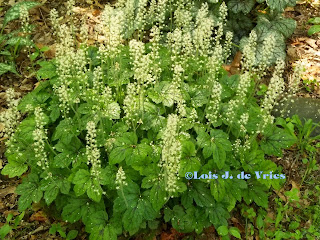
Zen Master Shunryu Suzuki popularized the term "Beginner's Mind" in America. He tells us: "In the beginner's mind, there are many possibilities, but in the expert's mind there are few." This is also true in gardening, as I learned just the other day. Dan had joined me in my evening garden rounds, during which I point out what has bloomed since last time (usually yesterday), and what difficult weed (this week it's curly dock) is beyond my capability to pull out and requires his attention. This year, the Tiarella (Foam flower, left ) are particularly robust and covered with magnificent blooms. As Dan admired these, he pointed toward Heuchera Venus (Coral Bells, right ) and wondered why its flowers were so much taller and so much farther behind "those other ones." I'm sure I must have rolled my eyes as I explained that they were two entirely different plants. "Look, the Tiarella leaves are all sharp and pointy – t...

Gardener's Psychiatric Hotline

Image
Guest Blog The Gardener’s Psychiatric Hotline has been a perennial favorite for garden humor, which those of us in the Northeast could use a little of right now. Thanks to Ron Vanderhoff of Roger’s Gardens for his version: “Many who read this column will soon retreat to their gardens for long periods of time. Once there, may will find peace, harmony, and beauty. But a few, some of whom I’ve met, will discover other, darker, qualities of the season. At this season, I worry about many of my dear gardening friends. When talking to them, I see some of the early signs; the soft mumblings, the subtle mood swings, the small nervous tics. I suspect some of these garden comrades are only a dandelion or two away from serious floral psychosis. The annual anticipation of spring, mingled and juxtaposed with delirious expectations of plant perfection and the uncertainties of nature, drive some of my fragile friends to the brink. These people need skilled help, carefully administered ...

Garden Time

Image
In last week’s blog, guest Eric Maisel raised the concept of re-imagining time so that “it is abundantly meaningful to turn to it (gardening) for short periods of time during the day rather than holding that, unless you have a huge expanse of time, there is no reason to bother.” This echoes the sentiments expressed by garden writer Marianne Binetti who believes that gardening is a legitimate task to be incorporated into every garden writer’s workday and that time should be set aside for it like other assignments or appointments. Marianne suggests the carrot-and-stick approach, in which the gardening interval is a reward for completing our less palatable duties. I seems much easier to get into the garden, than to get out of it, however. All serious gardeners are familiar with the elasticity of time, something we are told is a fixed unit. We’re taught that every second is the same length, determined by atomic clocks based on the hyperfine (microwave) transitions in hydrogen-1, ce...

Winter Rituals

Image
Some people complain about the avalanche of plant catalogs that begins to arrive this time of the year, but I look forward to them. While winter has its own charms, color is not one of them and I miss it. Aside from the visual stimulation, though, the catalogs also sound the starting gun of an annual winter ritual at our place --- planning the next phase of the garden. Like any other ritual, it holds the elements of celebrating a particular occasion, focusing on a single subject, sustained concentration, the dreaminess of entering another world (of imagination), the consultation of sacred manuscripts (garden books and catalogs), and locking myself away from the world in my retreat house (snowed-in at the top of the hill). Dan, the financier, hole-digger, and hardscape constructor, participates as acolyte. Towards the end of the ceremonies, I speak the hallowed liturgical phrases that have been handed down from time immemorial by women gardeners: “Honey, can you please just do this o...

Papyrus Prolonged

Last spring I bought a 10-inch pot of Papyrus, not quite knowing what I would do with it. I already knew it wouldn’t survive in the shade where we have our fountain. How silly would THAT have looked, anyway? I had kept an umbrella Cyperus ( C. alternifolius ) in my sunny apartment when I was still in college. It was easy to care for (just add water) and was unusual enough for me to want to include it in my collection of 150 (really!) houseplants. The Papyrus ( C. papyrus ) was quite a bit more weird-looking, but I had always wanted one. I also knew that it was zone 9 or 10 and would not survive the winter outdoors. Oh well, it was a great bargain at just 10 bucks! I’m never sure what Dan’s reaction is going to be when I bring home a new plant. “Oh wow,” he said, “it looks like something from outer space. I love it!” When I explained the plant’s cultural needs and why it couldn’t go in the spot where we actually HAD water, his recommendation was to set it next to “those other a...

The Turkey’s Tale

Image
As we continue to eat Thanksgiving leftovers of every imaginable description, let us also give thanks that the wild turkey has been brought back from the brink of extinction. Abundant when the first settlers arrived on the East Coast of America, the native turkey was hunted for both its meat and feathers. As more and more of its woodland habitat was converted to urban areas, the combined effect of loss of habitat and uncontrolled hunting took its toll. In the early 1900s, the number of turkeys nationwide is believed to have dropped to 30,000 birds. Today, thanks to preservation efforts, there are nearly 7 million. In our neck of the woods, we still see turkeys running wild through the forest, nesting, and roosting in trees at night. In years past, we’ve been visited by as many as 32 birds at once (five hens and their broods). The guard hen gave a soft cluck when she felt it was safe for each bird to climb up into the yard from a lower plateau. With military precision, they fanned o...