Posts

Kid-Friendly Veggie Recipes

Image
Families who have to cope with a nightly struggle over who won’t eat what vegetable might be interested in the Love Your Veggies™ Campaign ( LoveYourVeggies.com ). Readers may also want to check out Chef Art Smith’s (photo) commonthreads.org to read about getting children involved with vegetable gardening and healthy cooking. I’m sure kids are not the only ones falling short of the recommended 2-5 cups of daily fruit and vegetables, so treat yourself to one of Art’s tasty dishes: Moroccan Chicken with Roasted Vegetable Couscous Ingredients: 1 cup whole wheat couscous 1 tablespoon vegetable oil 1 medium onion, chopped 2 bay leaves 5 whole cloves, crushed ½ teaspoon cinnamon 1 teaspoon dried, ground turmeric ¼ teaspoon ground cayenne pepper 6 skinless, boneless chicken breast halves, chopped 1 16-oz. can garbanzo beans 1 16-oz. can crushed tomatoes 1 48-oz. can chicken broth 2 carrots cut into ½-inch pieces 1 zucchini cut into ½-inch pieces 1 pa...

Gardening as Process: Planning and Mapping –2

Image
Once you’ve defined your activity areas, it’s time to take inventory of the plants you already have. At one extreme, a relatively new house will have next to nothing. At the other, your house, like mine, may be in the middle of the woods. On an open lot, you’ll probably want to plot every tree, large or small. In a mature garden, scalloped-edged bubbles can indicate a stand of deciduous trees; spikey-edged bubbles, an evergreen stand. If you have only a few young trees, you’ll need to imagine what they’ll look like when fully grown, for example into a 90-foot tall, three-foot diameter oak, with a canopy 50 feet wide. Your landscape map should indicate the mature size of your plants. Next, it’s time to edit. If you have a small city lot, take out that oak now, while you still can and replace it with a tree that’s more in keeping with the scale of your garden, a service tree ( Amelanchier) for example. Other readily available choices are ornamental cherry ( Prunus), flowering dog...

Gardening as Process: Planning and Mapping -1

Image
The next step in creating a garden is to map out what goes where. This can be as simple or complex as you like. You can purchase a computer-based design program, buy a plastic landscape template, or just make a bubble diagram. I prefer to start with a bubble diagram on 11” x 17” quadrille paper, which allows you to work on the larger scale needed to envision an entire yard. Use pencil and get a big eraser. Next, you need to step outside. Look around. What are your lines of sight? Where is your eye naturally drawn? For better or for worse, these are your existing focal points. It’s important to deal with reality here, because you’re gathering vital information that will make or break your garden design. Don’t shrink from drawing an arrow from your back door to your neighbor’s plastic play set, if that is the dominant element in your garden view. Until you address such 800-pound gorillas, the garden will never look right. Compare where your eye is drawn now to where you would like ...

Gardening as Process: Dreaming It into Existence

Image
Gardening is a process. Elements of that process are, in their own way, like the elements of any creative undertaking. You can’t somehow leap to a finished garden without going through all of the steps. Might as well make them fun. Since the manual labor of fashioning the garden takes place during the growing season, for most of us in the northern hemisphere fall or winter is the best time to take the first step in the process --- dreaming and planning. With a cup of cider to warm your hands, a fire in the fireplace, a fuzzy throw to snuggle under, a pile of books and magazines to stimulate ideas, and notebooks or sketchbooks to capture your thoughts, many a pleasant day can be devoted to what you want your garden to become. Since you’re just dreaming, you might as well put everything you could possibly want into your vision of the perfect garden (editing things out comes later). Lawn, no lawn, or minimal lawn? Border beds, island beds, or both? Trees, shrubs, annuals, or pere...

Propane Tank in the Garden, Revisited

Image
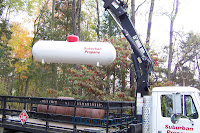
My karate teacher was fond of saying, “When you think you know, you don’t know.” Add in the old saws about not believing everything you hear and looks being deceiving, and you’ll understand why we changed our minds about moving our propane tank. (See original post at http://loisdevries.blogspot.com/2008/08/eyesores-in-garden.html ). It turned out not to be all that expensive: $50 for a permit; $40 for two trenching tools; and $106 for the propane company to send two installers and a boom truck to swap out the old tank for a new one. And we lucked out with the ledge --- we were able to dig down nearly a foot to create a new landing pad for the tank without hitting rock, even though the ledge juts out on either side of this spot. We dug and refilled the trench for the line to the house ourselves. There was one moment of trepidation when the installers told me that the boom wouldn’t reach the new site unless I let them drive their monstrous truck into my lavender garden. I hesita...

Edible Plants in the Landscape

Image
This month’s Garden Design Workshop is on edible plants http://www.gardeninggonewild.com/?p=2213#more-2213 . I doubt that there are many of us who don’t at least have a potted patio tomato every summer, if only in self-defense against those red tennis balls they sell in the supermarkets. This year, I added some type of super-100 hybrid cherry tomato that I grew from seed, and seedlings of Cherokee Purple, one of the best-tasting beefsteak-style tomatoes ever. If you’re a perfectionist, Cherokee Purple is not for you. The fruits grow into strange shapes, have a peculiar color that is neither green, nor purple, nor red, crack, and do not reveal when they’re ripe. Mine were clinging to their vines with an unbelievable tenacity way past the time they should have been picked, until I figured them out. Their thick skin doesn’t soften, either. I learned to bounce them around in my hand and try to “weigh” whether they were “done.” They were worth every bit of effort. The cherry tomatoes ...

CowPots™: Molded Manure

Image
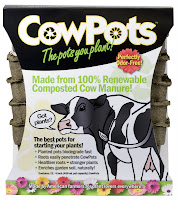
If you haven’t yet heard of them, CowPots™ are made from 100% Cow-Poo that is molded into plant pots for seedlings. They are about as organic as one can get and, unlike peat pots, completely renewable. (Insert feed into front of cow, raw material for pots exits at rear end.) When I spoke to inventor/dairy farmer Matt Freund at the Garden Writers symposium, I was beside myself with excitement as I listened to his story, because our little corner of New Jersey has lost nearly all of its dairy farms to housing developments. My passion for this product is on three levels. The first is that I love cows and Matt and his brother Ben have found a way to generate another income stream that can keep their small farm profitable. I still mourn the loss of the farm next door to me to a housing development in the 1980s. I had lived on that farm for a while as a child and, even after mom bought her own lot and built a small house with the help of Grandpa and my uncles, I still went down to help...